Collector Insights
Inside the Algorithm: A Journey Through Squiggle Metadata
Inside the Algorithm: A Journey Through Squiggle Metadata
by NiftyFifty
•
18 Aug 2025
“Proof of concept is my medium.”
—Snowfro
Prelude: Light, Color, Chance
When Erick Calderon (better known as Snowfro) speaks about art, he begins with light. Long before blockchains and browser-rendered code, he was experimenting with the way pigment meets illumination: glazing ceramic tiles at La Nova Tile, projecting gradients onto three-dimensional objects with the Light Art app and UpBlocks, even selling programmable LEDs through Sebbo Lights. Years of chasing pure chroma trained his eye to feel the temperature of every hue shift. Those exercises in color and light form the unseen prologue to the Chromie Squiggle.
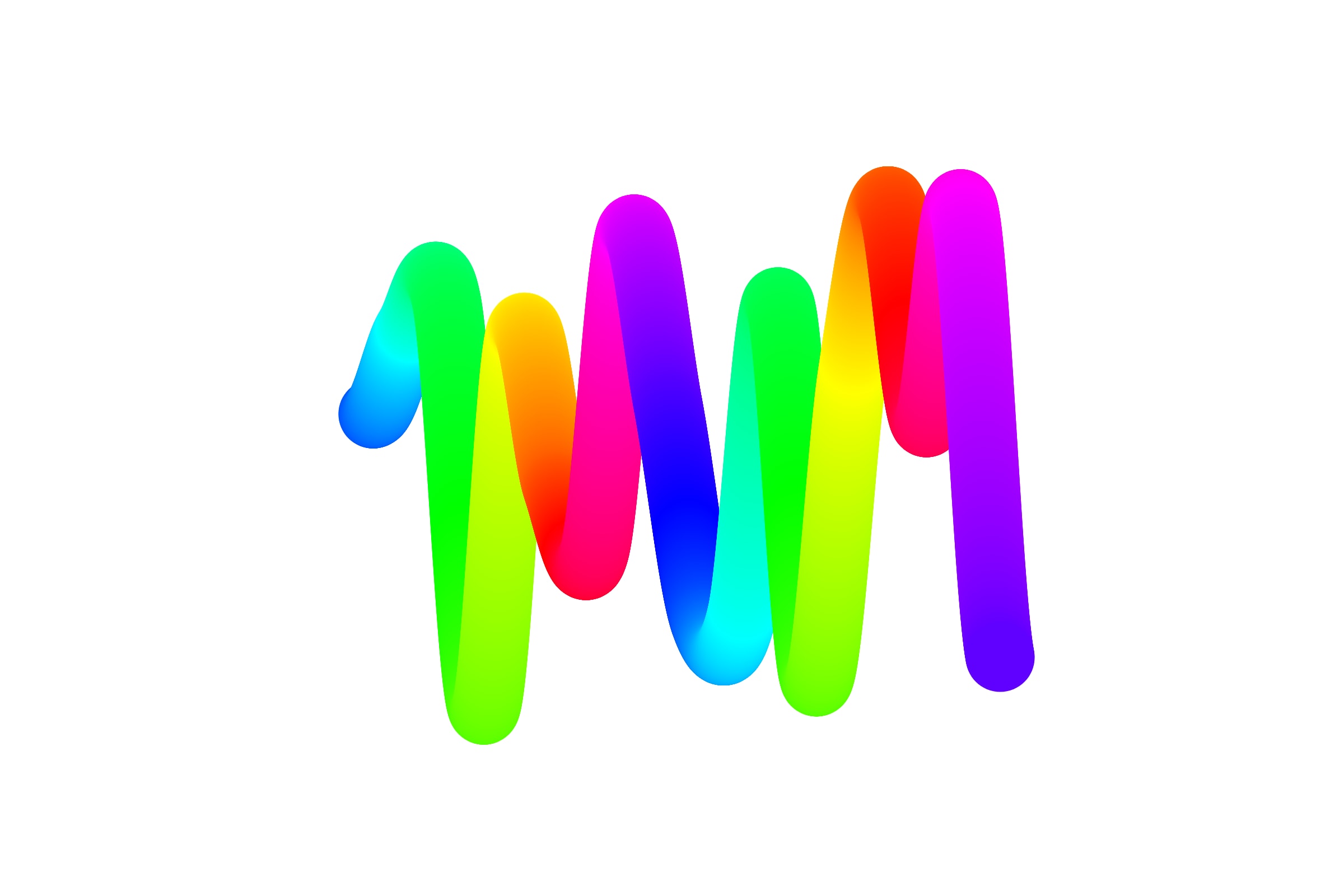
Simple at first sight (a single undulating line) the Squiggle is immediately recognizable, almost logo-like. Yet beneath that surface lies a trove of mathematical nuance and aesthetic intention vast enough to reward a lifetime of study. Two minutes of casual viewing reveal joyful waves of color; two years of focused research unveil nested systems of rarity, emergent traits, and cultural meaning.
Today, with all 10,000 Squiggles minted, the work stands complete: a canonical artifact of on-chain generative art. What follows is an essay that considers how a proof-of-concept became a movement-defining masterpiece.
1. Genesis: From Spaghetti to Signature
The first Squiggles, sketched in 2018, were affectionately nicknamed “Spaghetti Squiggles.” These thin, noodly curves (printed on business cards and gifted to interior designers) were early prototypes of a visual language that would, years later, become instantly recognizable. Calderon explored them the way a composer tests scales, with no plan for public release.
The flux-capacitor moment had already happened. In June 2017, while claiming CryptoPunks, Calderon realized the inequity of cherry-picking his favorite Zombies from a pre-minted set. What if the blockchain itself handled distribution, serving a random work the instant you clicked “mint”? That spark would become Art Blocks, a platform where the collector’s mint transaction generates the hash that seeds a unique on-chain artwork, making the transaction itself (and not the artist) the final curator of the piece. The inversion–algorithm first, curation after–has since become the gold standard for generative-art releases.
Calderon built the platform, but he still needed a “hello-world” project to prove it worked. The Squiggle, his Squiggle, became that demonstration: Project #0, so the artist released both the platform and its inaugural artwork simultaneously, embedding a signature in the very architecture of long-form generative art.
“Simple and easily identifiable, each Squiggle embodies the soul of the Art Blocks platform. Consider each my personal signature as an artist, developer, and tinkerer.” —Snowfro
2. Vocabulary of Form: Six Types, Six Hypers
The Squiggle’s formal language did not arrive fully-formed; it crystallized through two years of playful code edits and lucky accidents. Snowfro began with a single Regular line (he still calls it “Regular” or “Normal”), but in late 2018 he experimented with lowering the Color Spread, compressing the gradient so tightly that the hues seemed to ignite. That single tweak birthed the Hyper Spectrum: the same undulating line, now (at least) ten times more vivid.
Next, he increased the circle size which made the Normal feel weightier; pushing that idea further, he ballooned the circles until the line became a chunky ribbon. That unexpected heft became the Bold.
Once Normals, Bolds, and Hypers were in place, Snowfro kept tinkering. He intentionally coiled the line into tight springs, creating the Slinky. While refining that code he accidentally left small breaks between segments, creating a ridged texture. The community would later dub this happy accident Ribbed. Stretching the Slinky further and “grounding” each coil yielded a solid beam, the Pipe, part accident, part design. Finally, he scattered tiny points along the path, thinking the result might fail; instead it produced a pointillist halo, the surprisingly successful and community favorite, Fuzzy.
By November 27, 2020, the six Types were set: Normal, Slinky, Fuzzy, Ribbed, Bold, and Pipe, plus their six chroma-boosted Hyper counterparts.
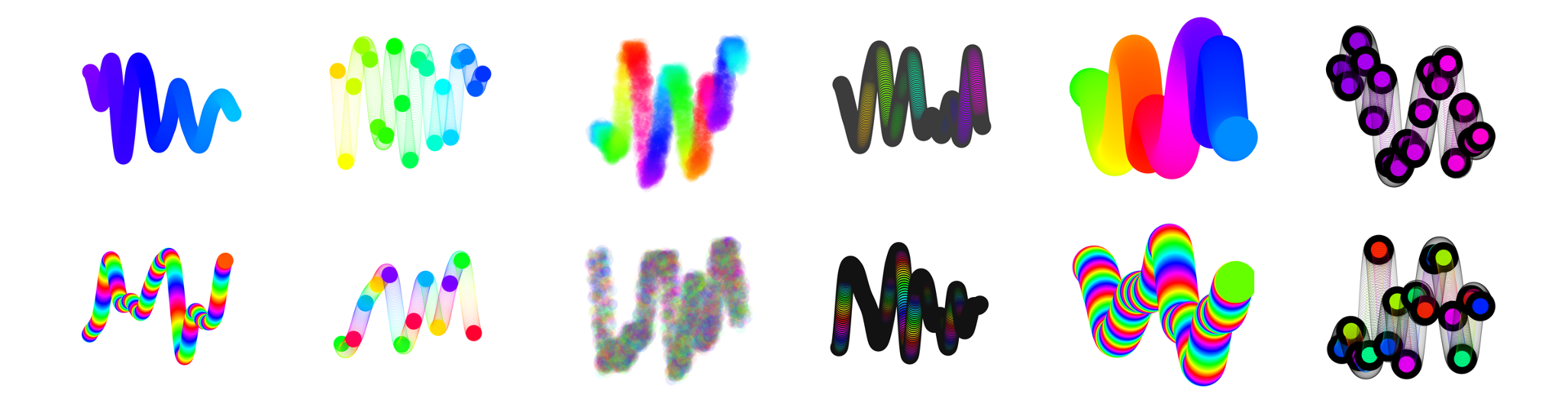
Out of all 10,000 Squiggles, the population breaks down as follows: 6,195 Normals, 1,145 Slinkies, 1,074 Fuzzies, 768 Ribbeds, 443 Bolds, and just 181 Pipes. Only 128 belong to the Hyper Spectrum. Most of those are Hyper Normals, but a few rarities stand out: Hyper Slinkies (13 total, prized for their elegance), Hyper Bolds (only 7), and Hyper Pipes (a mere 4), each coveted both for its scarcity and for the chroma-saturated beauty that Hyper mode unlocks.
These twelve categories were the sole official traits at launch. As collectors probed the algorithm they uncovered two spectral milestones: Perfect Spectrums (23 pieces that display all 256 hues exactly once) and Full Spectrums (43 pieces that land within one percent of that benchmark). Snowfro later enshrined those findings in the on-chain metadata, turning community discovery into canon. A 2023 deep dive showed that the “Perfect” and “Full” tags rely on rounded inputs (so a few overlooked Squiggles are arguably closer to spectral perfection than the canon list) but, much like Warhol’s prized misregistered screenprints, these hairline discrepancies have simply become another cherished layer of Squiggle lore.
Each Type is a discrete sentence; its Hyper variant is the same sentence amplified through a prism. Together they demonstrate how meaningful complexity can rise from the simplest of lines.
3. Community Traits: A Living Field Guide
The on-chain metadata provides the raw ingredients (Type, Spectrum, Steps, Segments, Color Spread, start and end hues, and more), but the Squiggle story is far richer. Collectors have spent years mining the algorithm for subtleties Snowfro never formally named, elevating those findings into an informal yet widely respected canon.
Day Zeros: the Dawn of the Collection
Every seasoned Squiggle aficionado begins with Day Zeros: the first 542 mints, running from #0 through #541 and all completed before midnight UTC on launch day, November 27, 2020. (The count feels off by one until you remember that #0, Snowfro’s personal proof mint, sits at the head of the set). Owning a Day Zero is like holding a first-edition print, historical provenance distilled into token form.
Harmonics & Ghosts: the Nuances of Ribbed
Click into any Squiggle and press the space-bar: the background cycles through eleven preset grayscale hues (0, 25, 50, … , 255). A Harmonic occurs when a Ribbed Squiggle’s rib color exactly matches one of those eleven presets; the ribs dissolve, the Squiggle seems to float, and the piece enters a state of chromatic camouflage.

A close relative of the Harmonic is the Ghost: a Ribbed whose rib color falls between 252 and 255. Against the default white backdrop, the Squiggle fades to an almost spectral after-image. Rarest of all are the so-called Perfect Whites: ribs that hit 255 exactly, hence qualifying also as Harmonics.
These subtleties explain why, after close study, many collectors come to share Snowfro’s own affection for Ribbeds. At first glance the mind jumps to a colorful Normal, yet Ribbeds reward slow looking with a staggering range, from chromatic fireworks to near-invisible ghosts. Little wonder, then, that Snowfro’s favorite Squiggle of all is #3259, a muted Greyed-Out Ribbed whose quiet complexity epitomizes the collection’s hidden depths. It is a deliberate counterbalance to another personal favorite: #1981, a vibrant Normal whose ID matches his birth year. The two pieces–one whispering, the other singing–bookend the spectrum of what a single algorithm can express.
Doubles, Triples & Rainbows: Peaks of Color
On the opposite end of subtlety lies the color-maximal milestones:
- Doubles compress roughly 512 hues, within one percent of showing every color twice.
- Triples reach about 768 hues, again within one percent of a theoretical “triple-perfect.”
- Two legendary Rainbow Normals (#1116 and #4739) hit the algorithmic ceiling at 801 hues.

Triples and Rainbows together constitute the top-ten most colorful Squiggles in the collection (when Hypers and Fuzzies are set aside), the radiant pinnacle of the series.
CS5s: Hidden Grails
Another coveted class, whispered about long before it was widely understood, is the CS5. Any Normal or Bold with the minimum non-Hyper Color Spread of 5 explodes into chromatic density. Just 80 such pieces exist.
Twins: Same DNA, Different Life
Occasionally two Squiggles emerge with identical metadata yet different shapes. 171 of these Twin pairs exist. They’re reminders that even with the same inputs the algorithm can produce wonderfully divergent outcomes, nature vs. nurture in code form.
Beyond these highlights lie dozens of other community-defined traits: Blacked-Outs, XLs, Talls, Rainbow Shorties, Monochromes, and more. Each discovered, named, and valued by collectors rather than by the original contract. A continually updated field guide lives at the SquiggleDAO Trait Explorer, proof that, even with the full 10,000 minted, the Chromie Squiggle remains an open text inviting new readings.
4. Turrell’s Influence: Color as Experience
Like James Turrell’s Skyspaces (which stage slow color transitions at twilight), Squiggles treat color not as pigment, but as time-based perception: gradients unfurl across Segments, guiding the eye the way a Turrell aperture guides the sky.
That lineage, from light art to code-based gradient, threads through Snowfro’s earlier experiments. La Nova Tile taught him to lay glazes so they break elegantly; Light Art and UpBlocks taught him to treat pixels as architectural material. The Squiggle algorithm inherits that discipline, translating physical chroma into digital spectra.
5. Epilogue: A Line That Keeps Opening
Stand in front of a Squiggle, projected stories high or glowing on a phone, and the first impression is disarming simplicity: one luminous stroke, looping from left to right. Yet every pixel of that line is the hard-won distillation of a decade spent refining light, color, and chance.
The algorithm that draws it is now frozen on Ethereum, the edition size locked at ten thousand, yet the artwork is anything but finished. With each new context–a three-story screen in NYC, a museum wall in Karlsruhe, or a collector’s wallet in Madrid–the algorithm awakens again, recomposing itself against fresh light and fresh eyes. Collectors still unearth overlooked traits, curators stage “Ribbed-only” exhibitions, children tap a Squiggle, watch it move, and hit the spacebar to discover Harmonics for the first time. In this sense the Squiggle behaves less like a static image and more like a living syllabus: inviting, inexhaustible, eternally remixed.
Its achievement is twofold. First, it proved that a blockchain can be more than a receipt; it can be a collaborator that finishes the artwork at the moment of mint. Second, it distilled that proof-of-concept into an icon so concise that anyone, anywhere, can recognize it in a heartbeat. Like Turrell’s twilight chambers, the Chromie Squiggle turns pure color into an experience of time, one that begins with a click and unfolds for as long as viewers are willing to look.
NiftyFifty (SquiggleDAO)
Disclosure: The author is part of SquiggleDAO, which holds Squiggles including Traits discussed in this essay.