Exhibition
Agents at Play in Emily Xie's Tensile Forms
Agents at Play in Emily Xie's Tensile Forms
by Tonya Lobato
•
18 Nov 2026
Agents at Play: Emily Xie's Tensile Forms
On exhibit at Art Basel Miami Beach, 2026, for Zero 10
Tensile adj. of, relating to, or involving tension
Tension is a familiar concept in artistic works, something that creatives of all types, painters, musicians, embroiderers, novelists, strive and sometimes struggle to balance. Tension is the essence that can capture emotion, engage people on an aesthetic or psychological level, cause them to linger, to think. Too much tension can repel, while too little fails to inspire or hold a work together, like a loose thread on the underside of a seam.
Emily Xie has managed to delicately balance tension across several different aspects of her Tensile Forms series of large hand-embroidered artworks, as well as in her Tensile Constructs set of smaller, machine-produced works. In the artworks themselves, and throughout the process of their creation, Xie’s careful equipoise, an alignment of disparate energies, makes them compelling from their coded origin through to their final manifestation as intricately detailed embroideries.
Whether viewing Xie’s works from a distance or studying details up close, there is a palpable energy. As with several of her past works, she has crafted the base forms from code to be figurative, to represent something recognizable and spark emotion. Viewers might see different things, a great writhing dragon or battling tragic heroes; maybe a buoyant sea creature, or birds taking flight. Regardless of interpretation, there is unmistakable energy in the compositions, a bubbling pressure like the pending climax of a novel.
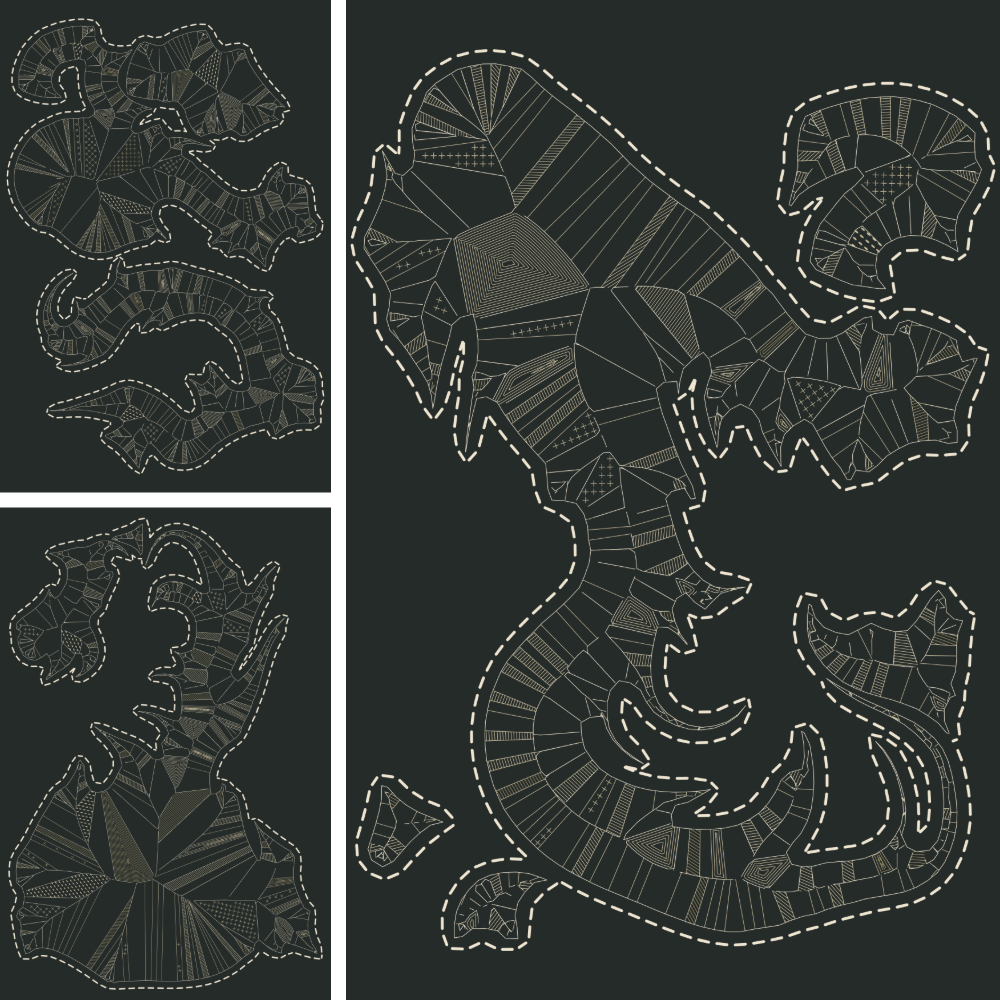
Zooming in on Tensile Forms, the details of the patterns, colors, and textures, captured through intricate hand stitching, tell their own story. One might see the complex inner workings of cells, or imagine teeming microscopic life in a cup of ocean water. Or maybe the details recall a story: a fiery event in human history or the interconnected networks of the silk road.
The level of attention that Xie has lavished on her compositions of elements that embellish the underlying algorithmic form is impressive. In Tensile Forms, she uses a collage process that begins with an AI assist to get ideas flowing, but often ends in an entirely different direction, one that is a result of many hours of almost obsessive manual combining and recombining of competing and complementary elements to arrive at something visually and instinctively satisfying for her.
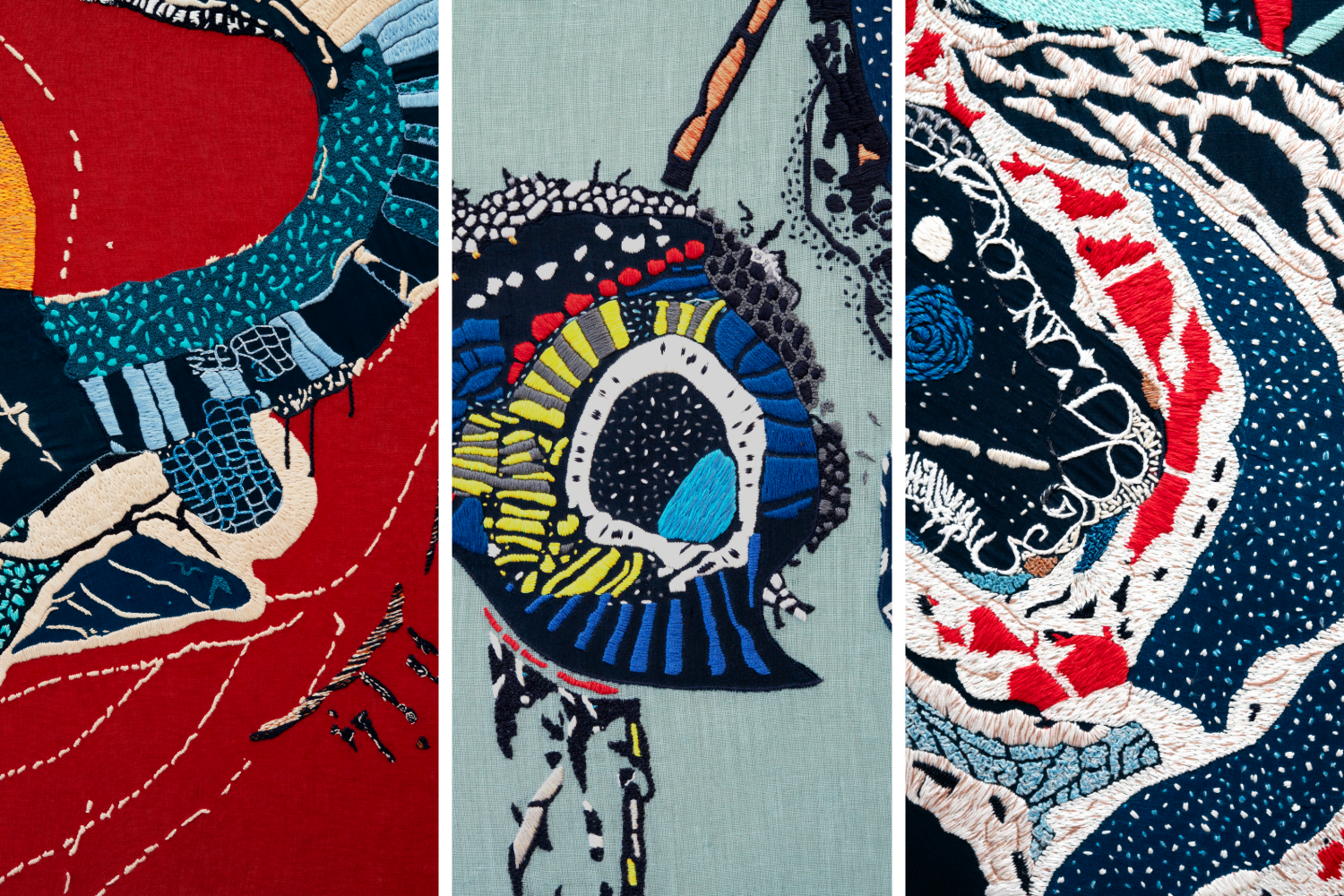
Xie admits she sometimes doesn’t know when to stop: “If given infinite time, it will stretch out for me because I will want to continue tinkering.” To get lost in the details is to see things on a different level: What to Xie is a weighty decision in aesthetic integrity and storytelling might be to someone else almost imperceptible. Xie laughs and relates “It’s funny because I'll make a round of edits and I'll show my husband and ask: which one do you like better, this one, or this one? And he’ll say, Emily, I don't know, they look the same. And I start realizing, I need to stop with the tiny details … nobody notices them.” But the finely tuned aesthetic qualities in Xie’s artworks are part of the allure.
Just as noteworthy is a less visible layer of orchestration in her creative process. A narrative around “agency” arises from the different modes in which she has produced her works, which stem from human ingenuity as well as machine proficiency. She allows various agents to retain autonomy for a period of time, or for a specific part of the process, making decisions that affect the outcome.
In this way, she plays a role more akin to conductor or director than traditional artist. Rather than relying on a primary medium to execute a work independently, Xie directs an ensemble. She begins with the algorithm, which she crafts through code and layers of elements. But she soon loosens the baton to outside forces: The compute power of the machine for generating variability within her parameters, AI for visualizing ideas that embellish the base forms, and over to artisans in India who work the embroideries, based on Xie’s final digital collages, entirely by hand.
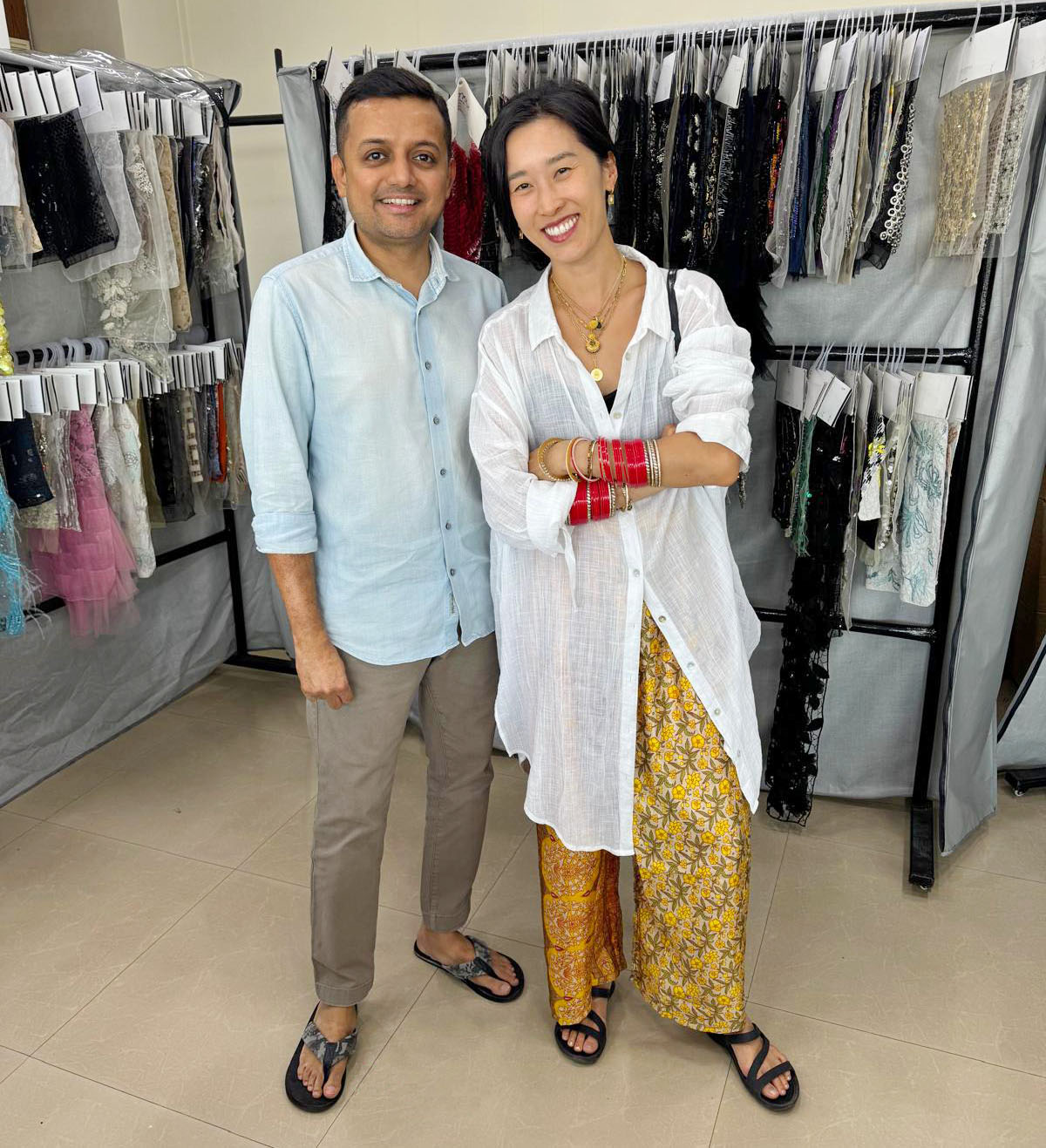
Xie chose India as the place for production because of its long history in textile arts and embroidery, but also, she relates, because of a personal connection: “My husband's Indian. My child's half Indian. So India is really quite a special connection.” This connection, with plenty of reasons to go back and forth, has given her the time and ability to pinpoint a reputable embroidery studio that meets her expectations for outstanding craftsmanship. Xie says: “They actually tend to do fashion embroidery for major art fashion houses…. Bringing that sort of aesthetic eye into art was something that was really interesting to me.”
Despite a clear passion for hand craft, Xie is not afraid of using machines, including AI, to achieve desired results. She says “I really care mostly about the output … I am not the type of generative artist who refuses to use AI … it’s a tool.” In Tensile Constructs, the complementary but more simplified counterpart to Tensile Forms, code is sent directly from computer to embroidery machine, revealing works that are the purest visual and conceptual representation of Xie’s base algorithm. Her curatorial hand is reflected in the final set of artworks, favorites she chose from among a considerable number of algorithmic possibilities.
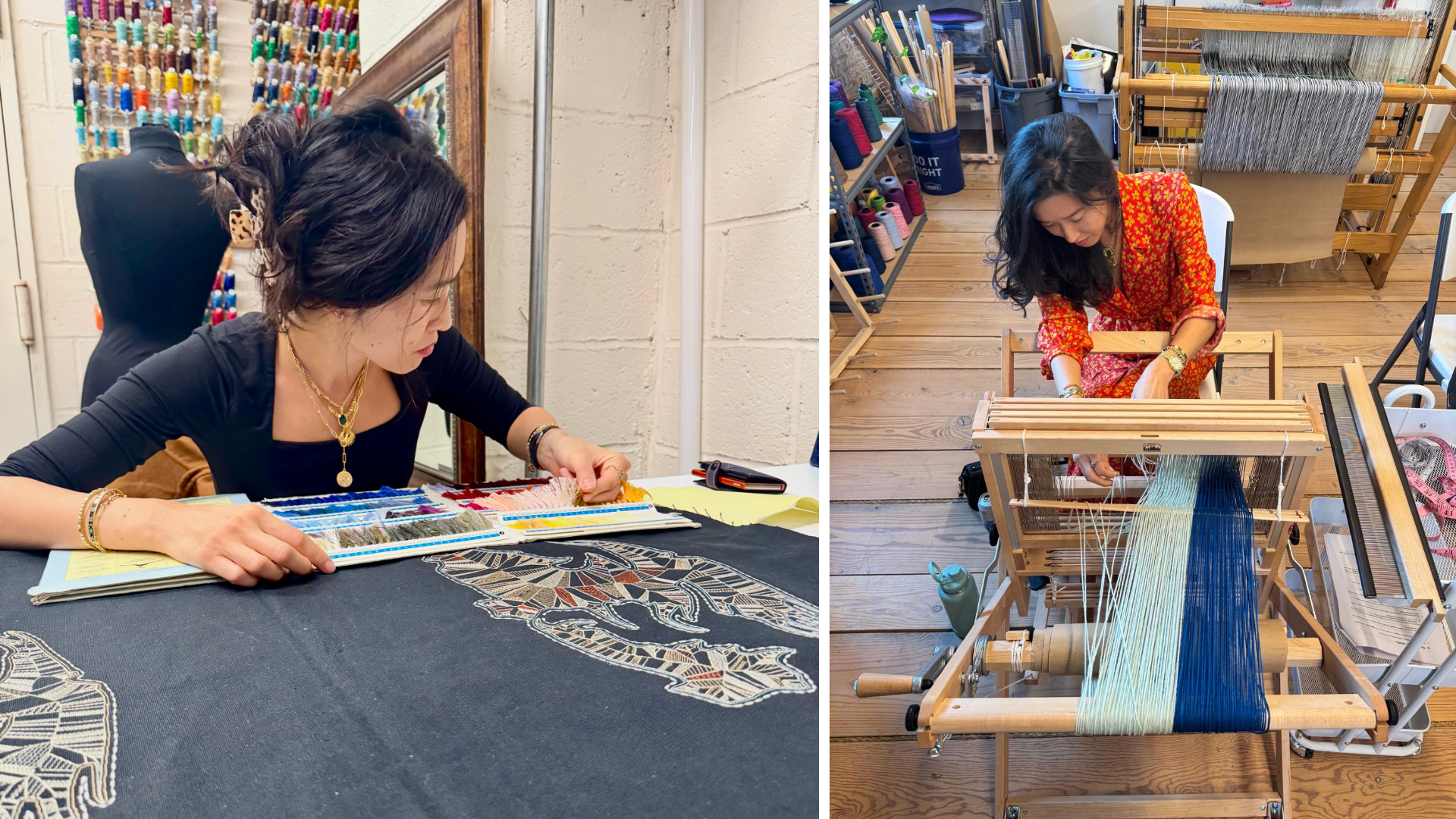
At many points in the process of either set of works, Forms or Constructs, one implying a more sculpted endeavor, the other a more rule-based build, there’s a level of trust that comes into play. Xie’s various instruments can reverberate in unexpected ways: Humans can misinterpret and machines can glitch. But she is undaunted; the contradictions are a driving force of the artwork: “The whole exhibition is about this juxtaposition of machine and hand, this idea of granting agency in different ways … putting the machine, pure algorithm, in dialogue with one of the most human things, one of the oldest forms of making.”
When one thinks about the sheer number of individual stitches across the two series, it’s remarkable. Whether stitched by hand or machine, each tiny stitch is placed with a precisely balanced tension that ensures it stays in place and performs its role in the larger story. It is Xie though, with ultimate agency, who is most notable. She is the one who has pulled the narrative string of the work from beginning to end, resulting in cohesive outputs that resonate with possibility and make us marvel at the intricate and sometimes contradictory pathway that leads from immaterial to material.
Tensile Forms, including Tensile Constructs, by Emily Xie will be presented at Art Basel Miami Beach, part of the Zero 10 exhibition, from December 2–6, 2026. The series comprises four large scale hand-embroidered works (Forms) and six smaller scale machine-embroidered works (Constructs). Additional small scale works from the Constructs set will be minted live at the booth and online throughout the fair.
Please refer to our catalog for complete details and purchase information.