Artist Insights
Harvey Rayner at Art Basel Hong Kong: Algorithmic Synesthesia
Harvey Rayner at Art Basel Hong Kong: Algorithmic Synesthesia
by Art Blocks Editorial
•
18 Mar 2026
Harvey Rayner at Art Basel: Algorithmic Synesthesia
We met with Art Blocks 500 artist Harvey Rayner to hear about his debut at Art Basel and learn about his new project, Algorithmic Synesthesia, on display in Hong Kong as part of Art Basel's digital art initiative, Zero 10.
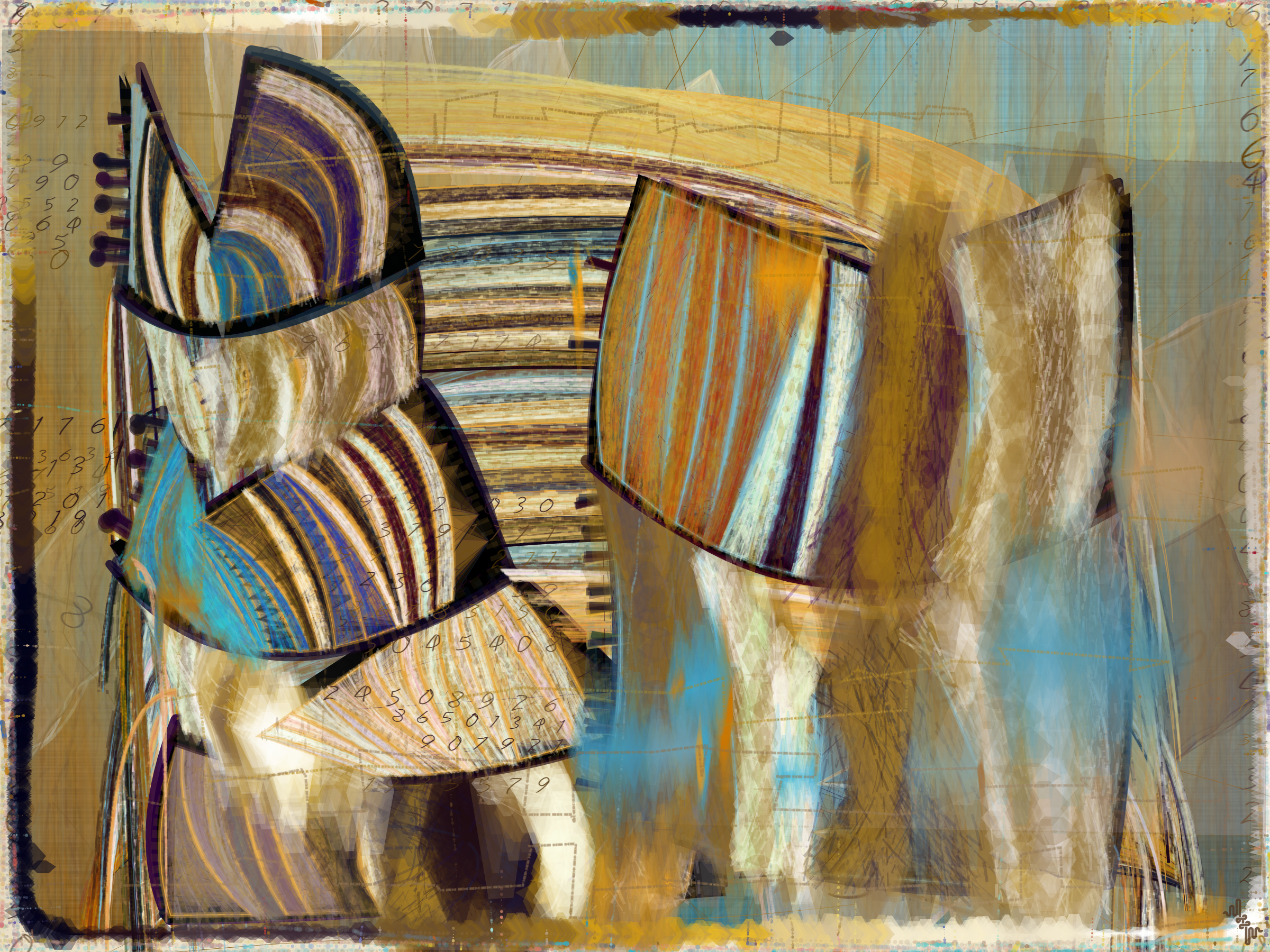
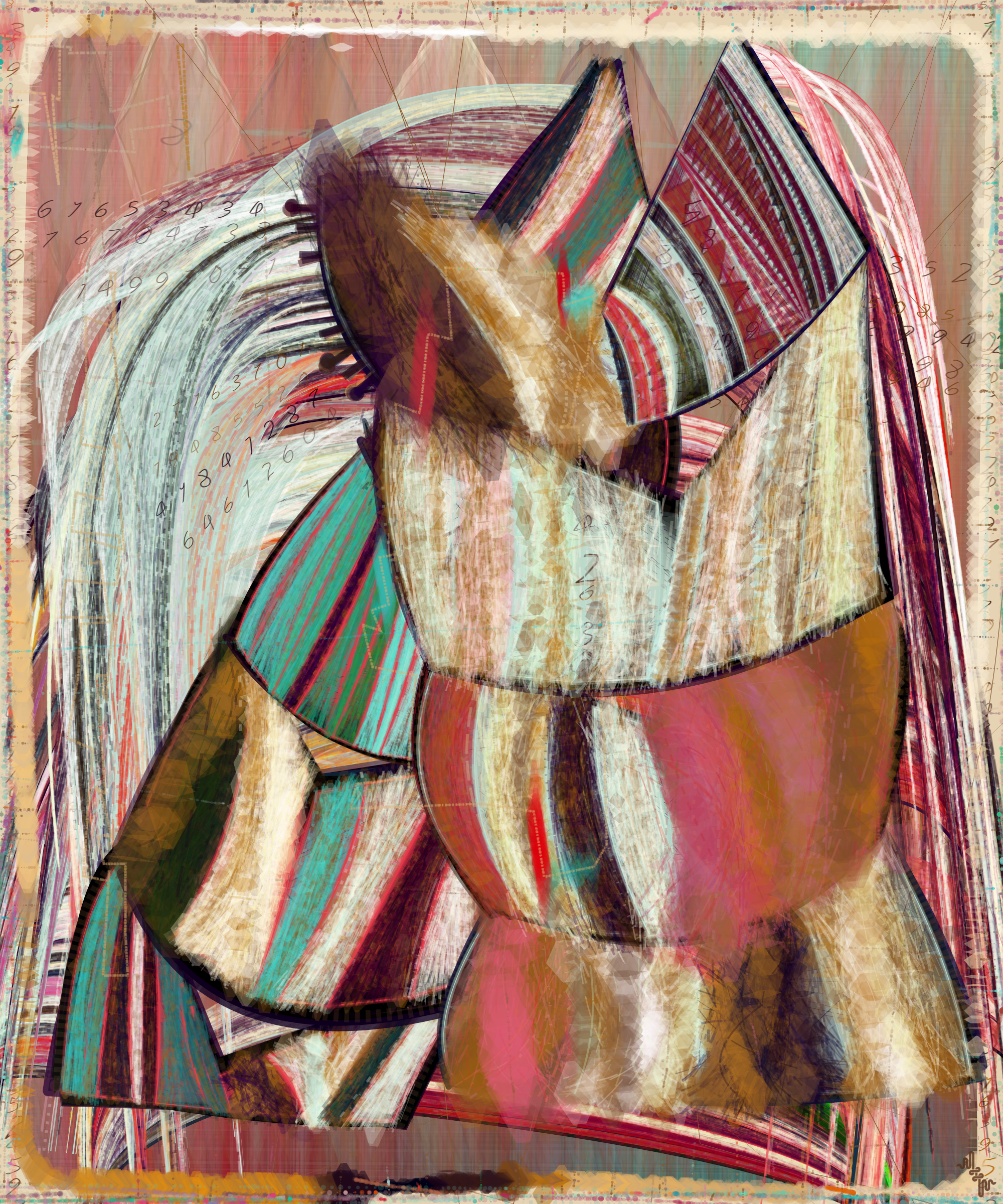
Algorithmic Synesthesia, a long-form generative project, will bridge digital and physical by allowing visitors to generate and select their preferred, unique artwork on site using the algorithm, and receive a physical print to complement the digital output. In addition, a limited edition series of Artist Curated pieces, carefully selected by Rayner, will be available for sale as large-scale, archival prints. Art Basel Hong Kong is open to the public from March 27 - 29, 2026. VIP access begins March 25.
How does it feel to be exhibiting at Art Basel?
I don't know if excited is the right word, but it's something I've been wanting to do for a long time. In some respects, it feels fitting as I've been a dedicated artist for over 30 years; and of course I believe in what I create, but at the same time it feels very surreal to have this opportunity when many talented artists never get the chance to show at the main fair. They usually only exhibit international artists with an extensive CV; and my CV, from a more conventional perspective, is not so impressive. Ultimately it's a great opportunity to test something that I've been wanting to do for a long time in front of an audience that isn't Web3.
Tell us about Algorithmic Synesthesia and the inspiration for the project.
I guess if there was an inspiration, it was something that I had in my mind, a way of painting that I explored when I was in my twenties. I bounced around and tried all different kinds of visual languages back then. There was a certain way of constructing three dimensional forms that I wanted to go back to and explore with an algorithm.
The nature of this project is very “painterly” in appearance. How did you achieve that through code?
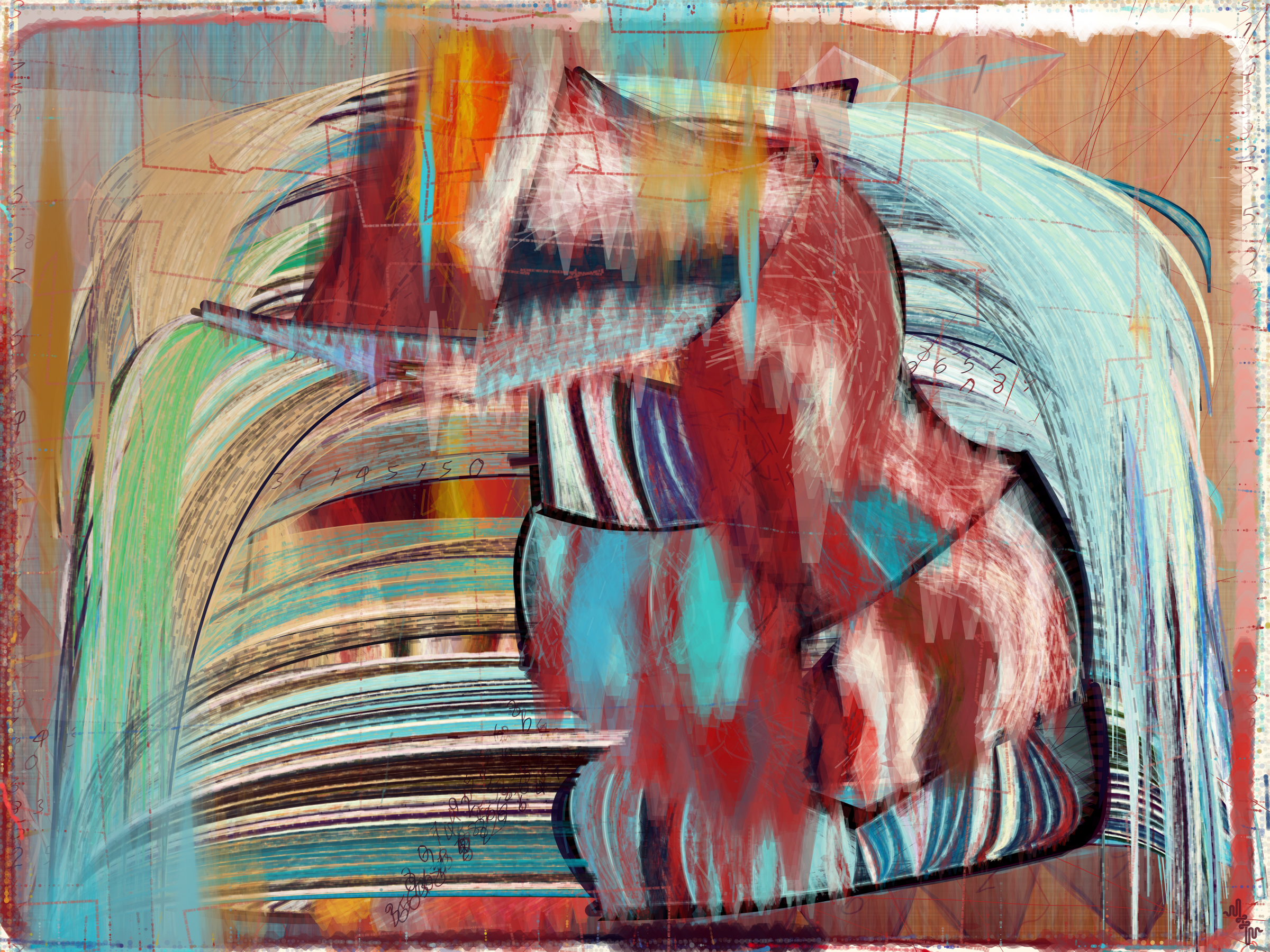
Right. I feel like this is actually the next step in the evolution of where I'm heading. So, it's kind of counterintuitive because I actually use what's called SVG, which is vector graphics. The typical application of vector graphics that most people are familiar with doesn't look like paint at all, but it's just many, many layers—tens of thousands of objects layered on top of each other. Many of them are translucent to some degree. Every time a primitive or building block is rendered, it's varied a little bit.
So there's variability in the way all of these different elements are arranged, but also variability within the elements?
Yes, absolutely. And that's also true for the color of every element. So, basically, if there's a property to one of those primitives, I will vary every possible property. Nothing will remain the same, whether it's the width of the stroke, or the spacing. I use a lot of dashed lines and if you look at them closely you can see the spacing of those dashes and the thickness of the lines are always different. So that's where the randomness is coming in to create that deep texture.
How did the project evolve from the first outputs to the ones you considered final. Did you alter the code base or constraints to achieve different results?
Yes, I'm always tweaking every part of it. I used to be a painter. I haven't painted for over 20 years, but it's a very similar process. You start with a basic architecture and you refine it. Sometimes it will change very radically.
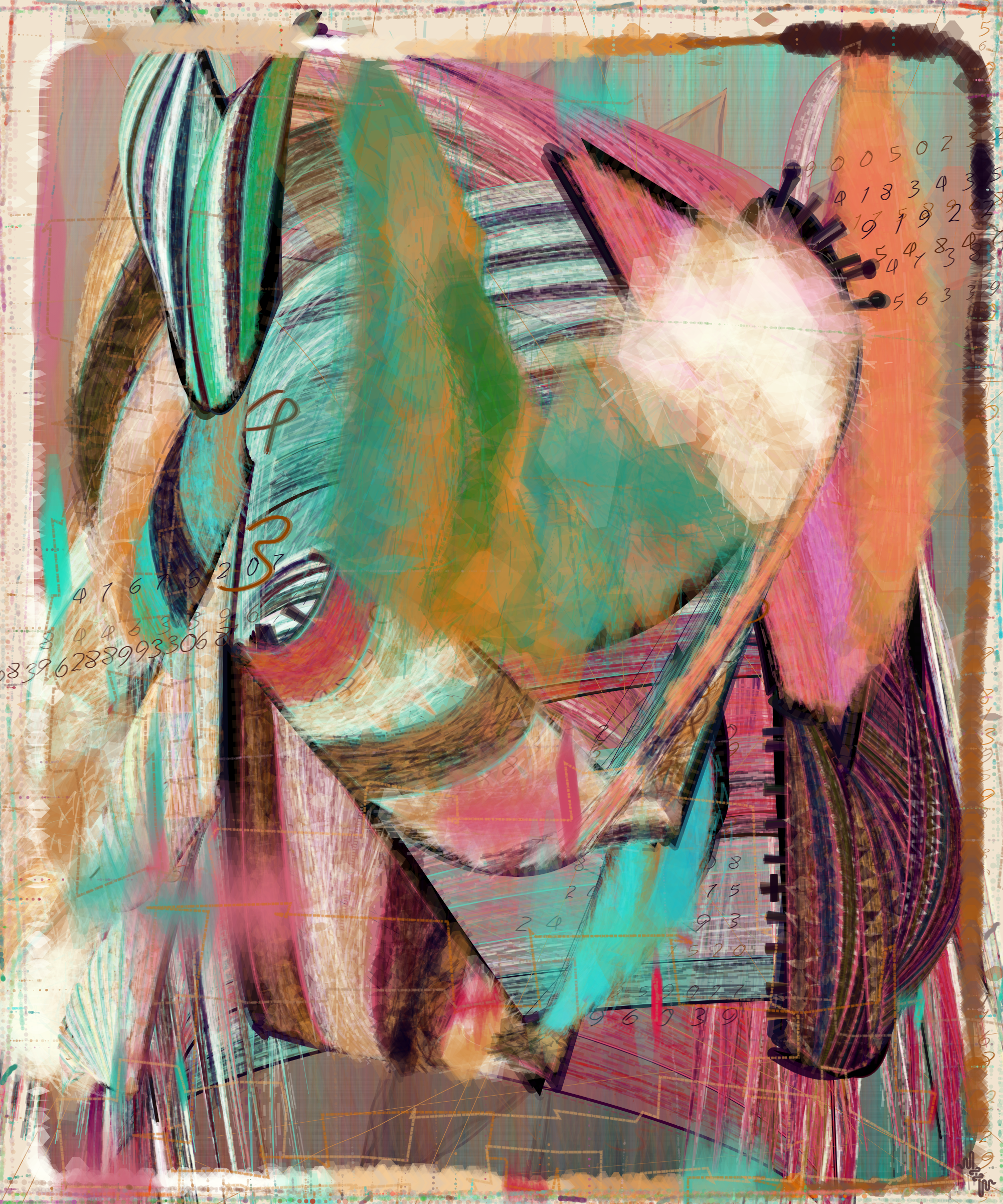
I try to have three or four different basic building blocks that I work with. In this one, there are three main building blocks. You've got the background element, which is this diamond-type structure that was inspired by Picasso's rose period. Then there are sculptural, stacked elements that I call towers. I really wanted them to look like they're carrying each other, like figures. Then there are elements that come out from the sides that I call outflows.
So there are three basic primitives. But during the process of making the work, I'm always introducing a new primitive, seeing if it works, and often taking it away to store it for another project. You can almost evaluate the quality of a project by how many good things you've thrown away. Sometimes just because you can add something doesn't mean you should add it.
How would you say that the visual quality of your work has evolved over time?
Over the last 30 years it's changed incredibly because I used to work in such a constrained way. The big journey for me has been moving towards this kind of free style. The way I work now is actually much more like the abstract painting I used to make which was very free and gestural. When I was at art school I explored so many different styles. It was almost like a crisis. It felt too boundless. I had too many options. I needed something to anchor me and limit what I could do. Imagine if you had a piano and it had 10,000 keys. It would be overwhelming. You need constraints in order to express yourself. It was geometry that gave me that constraint.
It wasn't until Art Blocks that we had long-form generative art. It’s quite a different way to work, with the use of randomness. As I've explored, I've really developed my craft and now I can work in a way where I have a certain thing I want in my mind and I know how to get there.
What about the subject matter of your work?
I really enjoy working with this more organic, expressive work. I've always wanted to make work that connects with people's emotions. If you look at my work throughout my life, I didn't really do that. But I've always wanted to and I keep trying. Work that is very clean and graphical and not deeply textured doesn't touch me in the same way. The things I want to live with touch me on an emotional level. So I'm going to keep moving in this direction. It really excites me.
As humans I think we're fine-tuned for certain things: the way the human body moves. One thing I noticed with Amplitudes of Canvas was the way certain elements looked like figures. They were kind of bent over and contorted. They had this kind of expression that I was after. So this project was building on that. I like this idea of figures in little contained spaces, on stages, almost like dancing. I like the ones where you've got two forms and they're almost leaning against each other; or one is recoiling and one is being more aggressive.
Although it's abstract, there needs to be something that's relatable. The writing is also something relatable, the fact that it looks like it's written by hand. It’s this kind of tension between what's handmade and what's machine made.
Tell us about your process for selecting the ten “Artist Curated” editions that will be available for Art Basel.
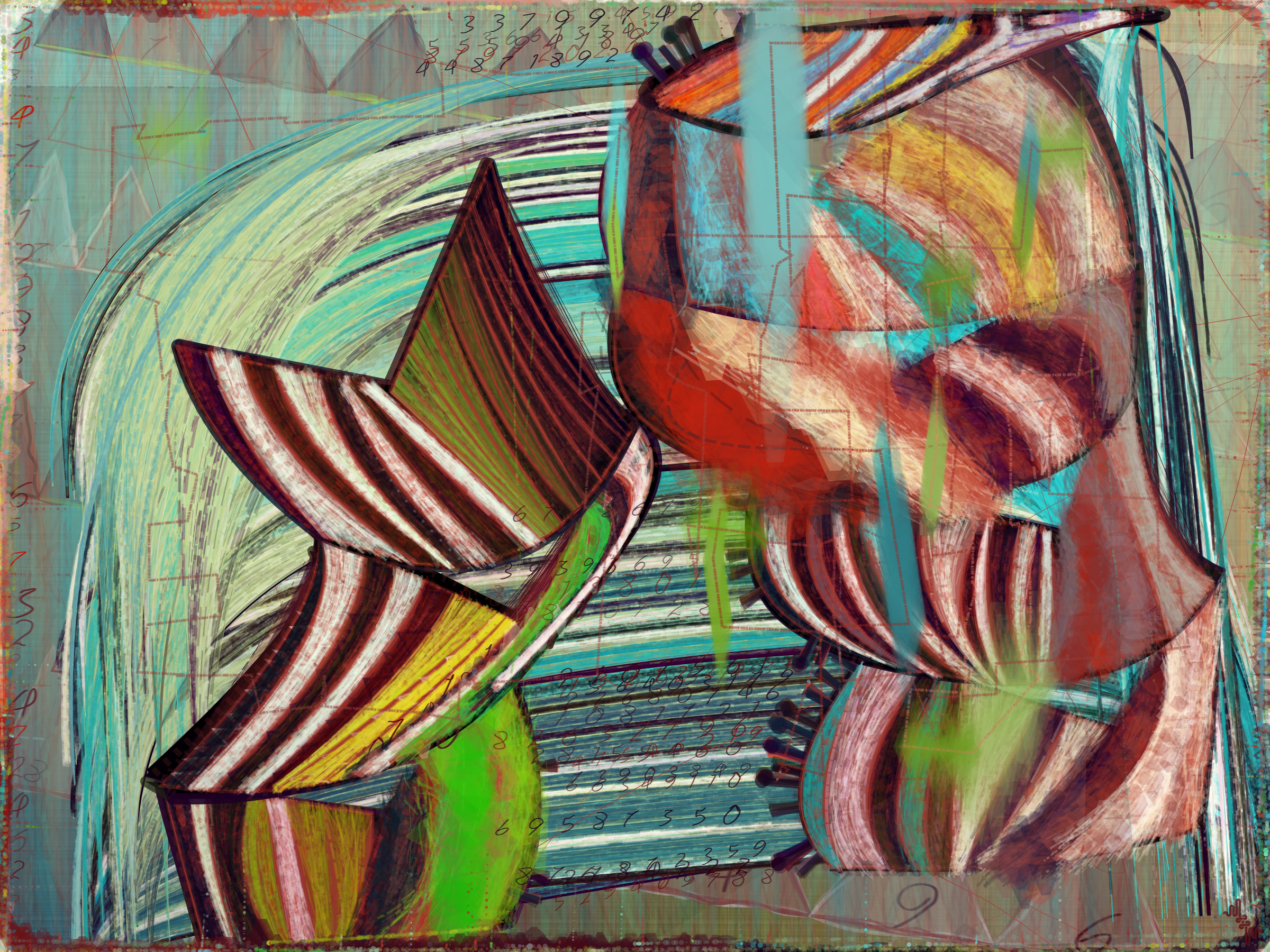
I generate thousands basically. I spend days just generating loads. First, I look at them big; and then I save them as a thumbnail. They have to grab my attention as a thumbnail. So I work on both scales. Then I'll put several into another folder and print them out and hang them on the walls for a few days or a few weeks. Slowly, the ones I feel are the strongest—which have personality, that have a story—that becomes clear. I've seen thousands more since this process and I'm still really happy with the ones I chose.
What else is special about the Artist Curated editions?
They're printed very large and framed. They're signed. I also gave them names. These names aren’t algorithmically generated, but I came up with them in response to each work. These works are also in a separate series of just 12. (I will keep two, so there are ten for sale.) This is the first series that I've personally curated for collectors.
What is on display at your Zero 10 exhibition and what should visitors look forward to?
When they turn up to the booth, there's going to be large prints on the wall to give you a sense of what the art looks like at scale. They have such a different presence when they're large and you can see how work is put together. It’s like looking at it with a magnifying glass. You can see how I build everything with vector elements.
Then there'll be an island with tablets. On each tablet will be the generator. So people will be able to hit generate and explore the algorithm to compare and find one they like. Once they've found one, they can collect it. It's minted to the collection and there's also a print generated.
The idea that somebody can turn up at a show and walk away with a unique piece of art from the artist, at an accessible price, will be quite wild for some visitors. Most people who go to Art Basel aren't expecting to come away with an original unique artwork from one of the artists there.
What do you want collectors to take away from this exhibition?
Ultimately, you know I'd love it if people have my work on their walls. It takes a long time for work to really reveal itself. When you just see it on a phone a few times, you may resonate with it, but it sometimes takes years to get a sense of why you really love the piece. For me, conceptual framing is a way into the work; but at the end of the day, if you have something on your wall, you forget about the concepts after a few years. You're left with the raw, intrinsic visual art. I'm always trying to create the thing that survives, that people have a relationship with.
We put a lot of thought into how the prints are going to be presented, the type of paper, how we treat the edge of the paper. This is all really important to me. We often think: oh let's call this a screen print and that a wood cut or whatever to make it more sellable. But I think the humble digital, modern print is an incredible thing. The colors are insane. You see forms and details in print that you don’t see on the screen.
We don't celebrate it enough, but the print is just as authentic an expression of static algorithmic art as a screen is. The algorithm at its core assigns color values to a surface—that surface can really be anything; but the modern printer has become a very evolved technology. The fidelity of a good print will surpass many if not all screens.
Explore the Artist Curated editions.
Please contact sales@artblocks.io with questions.