Collector Insights
God in the Algorithm - by Cozomo de’ Medici
God in the Algorithm - by Cozomo de’ Medici
by Cozomo de’ Medici
•
25 Sept 2025
Art made with code can feel like science.
Interesting technically, but often aesthetically boring.
In the long tale of on-chain generative art, there is one artwork that bucked this trend.
This work cut through the clutter of math and science, and put a dagger into the heart of the everyday art lover.
For me and thousands of others, that artwork is Fidenza.
That artist is Tyler Hobbs.

And the output that best captures this work, is #938… known throughout the community as God Mode Fidenza.
In art, as in life, we are fascinated by the unlikely.
Like the story of crypto itself, where with each bull run up we celebrate what feels like an unlikely ascent.
And on the way down, we pray to the crypto gods for an even more rare revival.
But as the asset class gets institutionalized, this feeling of the next crypto boom being a matter of thin odds starts to fade.
But that does not mean we stop searching for this feeling.
The place where we find it, though, does change.
Less so in crypto coins, and more in crypto art.
Its now famous counter clockwise spiral, the only one of its kind, paired with the deep dark blue background gives this work the illusion of a black hole.
Surrounding it, is a flaring vortex pulling us in.
And much like a blackhole, it’s difficult for us mere mortals to understand how #938 came to be.
What makes this output extraordinary is that its beauty is encoded in the mathematics of unlikelihood.
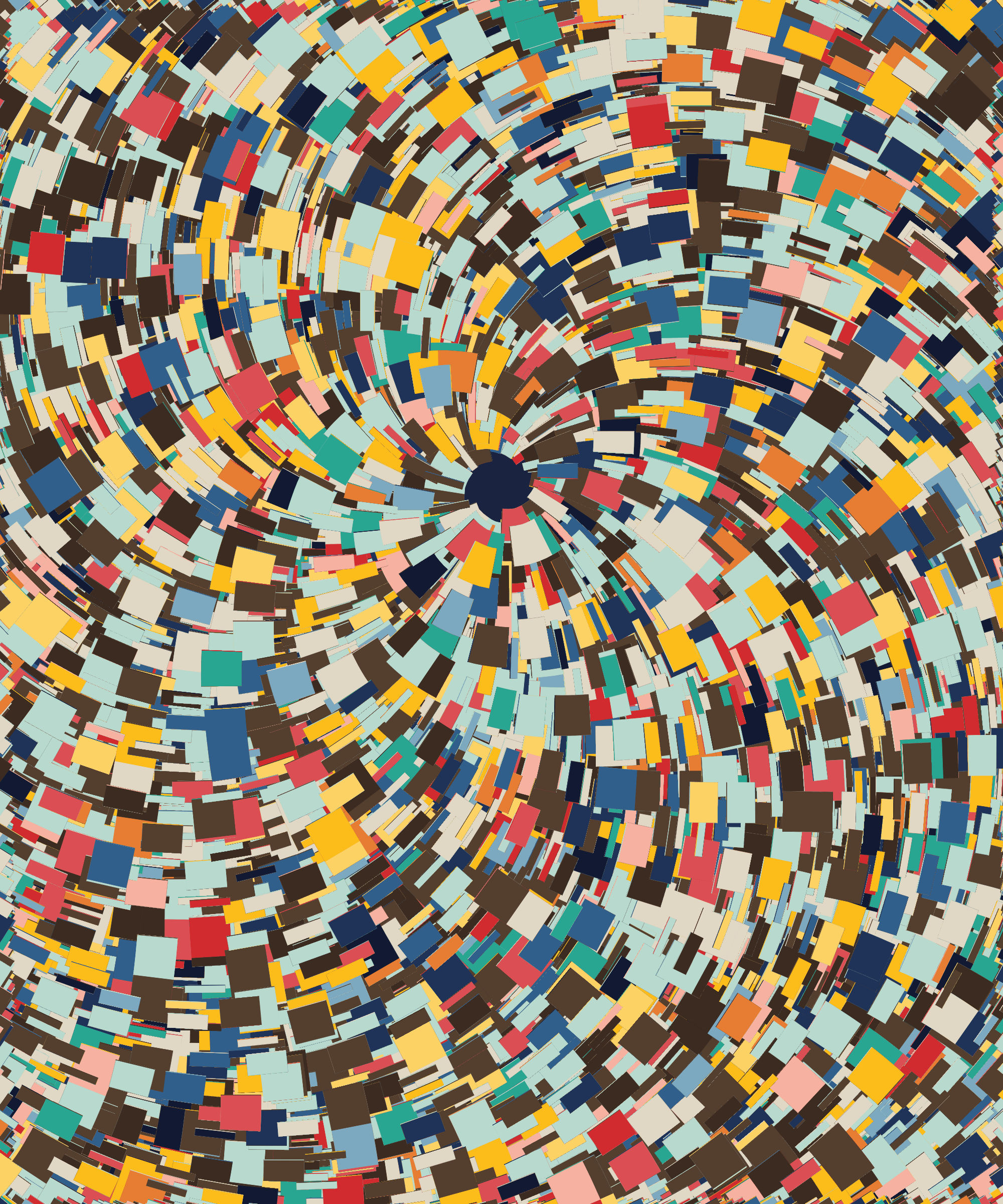
For this particular output to exist, an improbable stack of traits all had to combine:
- Micro-Uniform scale (4%) — every shape is drawn at an ultra-fine, consistent thickness, creating a delicate tapestry-like feel.
- Spiral flow field (4%) — instead of flowing randomly, the algorithm pulls every line into a hypnotic vortex.
- Relaxed collision checks (2%) — shapes are allowed to partially overlap, adding chaos and layering.
- Super Blocks (24%) — shapes are filled with square-like mosaics of color, giving the work a vibrant, pixelated rhythm.
- Luxe palette (53%) — the richest set of 16 colors in the system, producing kaleidoscopic depth.
Many of these traits on their own are rare.
Together, their convergence is almost statistically impossible… a one-in-a-thousand emergence.
This is what makes God Mode the signature example of emergence in generative art:
It’s a work born of strict rules and probabilities, yet so improbable it feels like divine intervention.
The question of how this Fidenza came to life is one I’ve asked myself many times.
After a great many long evenings of debate and discussion, there is only one conclusion that myself and my co-owners in the work Andrew Badr, Bonafidehan, Nick W, and ACtheCollector have come to.
And that’s this:
An output this unlikely could not have happened, unless God himself willed it into existence.
When Fidenza #938 was born, the algorithm turned on god mode.
This artifact I am proud to steward in The Medici Collection.